
What Leg Exercises Can I Do If Squats Hurt My Knees?
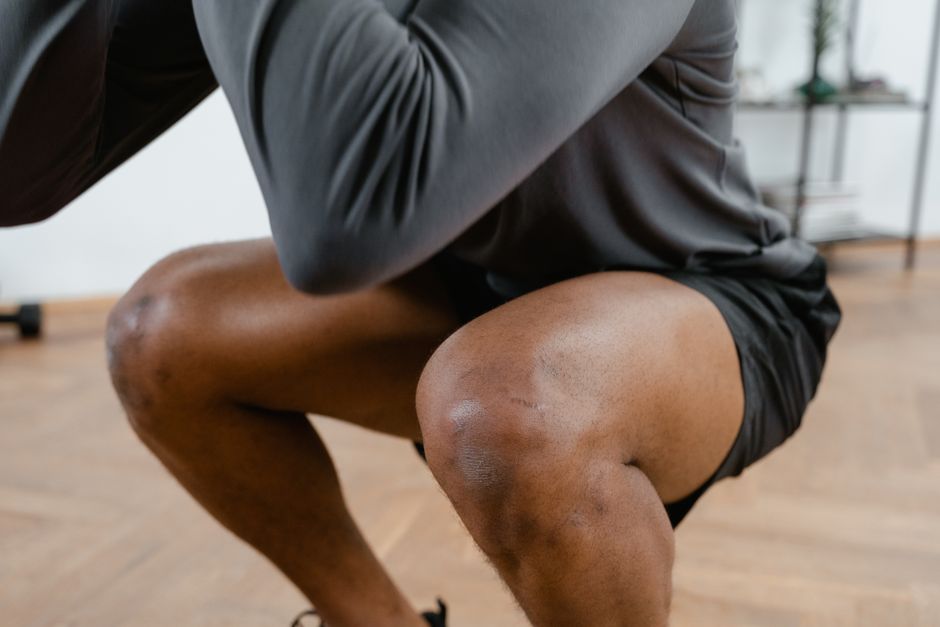
If squats hurt your knees, strengthen your legs with supported, smaller-range movements such as seated knee extensions, straight-leg raises, sit-to-stands from a higher chair, and gentle step-ups with a handrail. Start with a comfortable number of repetitions, move slowly, and adjust the range or repetitions if pain lingers. Muscle effort can be expected; a hot, red, swollen knee or trouble bearing weight needs medical assessment.
What leg exercises can I do if squats hurt my knees?
If squats hurt, try seated or supported leg exercises that let you control how much your knee bends. The aim is to train the quadriceps and nearby leg muscles without insisting on a deep squat. According to the Musculoskeletal Matters Dorset NHS, strengthening around the knee, particularly the quadriceps, can help with standing, walking, and climbing stairs.
Choose one or two movements to begin, then keep the first session simple:
- Seated knee extension: Sit in a stable chair and slowly straighten one knee within a comfortable range, then lower the foot with control.
- Static quadriceps contraction: Sit or lie with the leg supported and gently tighten the front thigh without forcing the knee to move.
- Straight-leg raise: Lie down with one knee bent and the other leg straight, tighten the thigh, and raise the straight leg only as far as you can control comfortably.
- Sit-to-stand: Rise from a stable chair and sit back down slowly. A higher seat or hands resting on the chair can make the movement easier.
The Royal Orthopaedic Hospital NHS Foundation Trust also lists straightening the knee over a rolled towel and mini-squats limited to 45 degrees. Its guidance says exercises should be performed gently and slowly. That smaller bend is a useful adjustment: reduce the depth first, rather than treating a full squat as the only way to build leg strength.
Start with fewer repetitions if needed and pay attention to the response after the session. DynamicHealth NHS recommends beginning with 5–8 repetitions, or fewer for comfort, and building gradually. Its suggested strength sessions are every other day; the best starting level depends on how the knee responds and what you can do with steady control.
How can I strengthen my thighs to make stairs easier?
To work toward easier stair climbing, practise controlled knee extensions, sit-to-stands, and supported step-ups at a manageable height. These movements train the leg muscles used for everyday tasks, and the Dorset NHS guidance specifically connects strengthening around the knee with standing up, walking, and climbing stairs.
Make the step-up a supported skill drill, not a test. Use a step that allows a controlled movement and hold a bannister or other stable support if needed. Step up and down slowly; if discomfort rises, reduce the step height or return to seated knee extensions for that session. The Royal Orthopaedic Hospital NHS Foundation Trust includes step-ups among its quadriceps-strengthening options.
Range of motion and load change how demanding an exercise feels. A shallow mini-squat asks for less knee bend than a deep squat; a higher chair makes a sit-to-stand easier than a low seat; and body weight can be a sufficient starting load before adding resistance. NIAMS, part of the U.S. National Institutes of Health, says exercise can reduce joint pain and stiffness and improve flexibility, muscle strength, and endurance in osteoarthritis. It recommends starting slowly and adjusting gradually, with options including bands or weights, water exercise, walking, cycling, and swimming.
There is no single exercise prescription that fits everyone. The American College of Rheumatology and Arthritis Foundation’s 2019 guideline strongly recommends exercise for people with knee, hip, or hand osteoarthritis, while recognizing aerobic, strengthening, resistance, isometric, and aquatic options. The guideline finds insufficient evidence to prescribe one ideal exercise type or dose for everyone, and notes that programs are often more effective with supervision, such as from a physical therapist. A practical takeaway: select a movement you can repeat with control and adapt it to your comfort, access, and preferences.
For a simple progression, change one feature at a time: add a few repetitions, increase the range slightly, or use a somewhat higher step. If the knee reacts poorly, reverse that change. Cycling or swimming may offer lower-joint-stress alternatives, as the Royal Orthopaedic Hospital NHS Foundation Trust notes.
Are chair squats safe for people with knee pain?
Chair squats, often called sit-to-stands, can be a manageable option for some people with knee pain when the chair is stable and the movement stays within a comfortable range. Dorset NHS includes sit-to-stands among accessible exercises and says to start with simple exercises and build up. A chair gives you a clear target and a way to make the movement easier by choosing a higher seat or using support.
Use a slow, repeatable pattern: place the chair behind you, lean forward enough to rise, stand without rushing, then lower yourself under control. Keep the bend shallow if a deeper movement brings on pain. You do not need to lower into a squat beyond what you can manage comfortably; the Royal Orthopaedic Hospital NHS Foundation Trust states that its mini-squat should be no more than 45 degrees.
Some muscle aching or a slight increase in pain may happen when beginning strengthening exercises. The Royal Orthopaedic Hospital NHS Foundation Trust advises reducing exercise during a flare-up and allowing exercise-related pain to settle before trying again. DynamicHealth NHS offers a more specific response guide: pain up to 4/10 during exercise can be acceptable if it settles within 45 minutes and does not affect sleep or next-day activities. These are source-specific guides, not a reason to push through worsening symptoms.
If discomfort goes beyond that guide, simplify the exercise: reduce the bend, do fewer repetitions, use more support, or switch to a seated option. Seek medical assessment for knee pain after trauma, inability to bear weight, a hot, red, or swollen knee, or a swollen and stiff knee, as advised by DynamicHealth NHS. A physical therapist can also help tailor and supervise a plan when choosing or progressing exercises is difficult.
Frequently Asked Questions
Should I stop exercising if my knee hurts during a leg workout?
Not every increase in discomfort means you need to stop all exercise. DynamicHealth NHS says pain up to 4/10 may be acceptable if it settles within 45 minutes and does not affect sleep or next-day activities; if it exceeds that guide, reduce the range or repetitions or choose an easier movement. Seek medical assessment for pain after trauma, inability to bear weight, a hot, red, or swollen knee, or a swollen and stiff knee.
How can I make leg exercises easier while I build strength?
Use support, reduce how far you bend or lift, and do fewer repetitions. For example, start sit-to-stands from a higher chair or practise knee extensions while seated. DynamicHealth NHS recommends starting with 5–8 repetitions, or fewer if needed for comfort, and building gradually.
For your next session, choose one movement, set up a version you can control, and note how your knee feels during the exercise and afterward. Keep the version that feels manageable; adjust the range or repetitions before deciding the exercise itself is off limits.
Sources
- Royal Orthopaedic Hospital NHS Foundation Trust: Exercises for osteoarthritis of the knee
- DynamicHealth NHS: Knee pain
- National Institute of Arthritis and Musculoskeletal and Skin Diseases (NIAMS), NIH
- American College of Rheumatology and Arthritis Foundation guideline
- Musculoskeletal Matters Dorset NHS
Disclaimer: This article is for general information only and is not medical advice. It is not a substitute for diagnosis or treatment by a qualified healthcare professional. Always speak to your doctor before acting on anything you read here.
Related guides
How to Choose a Gym with Clean Showers and Convenient Hours
Assess gym cleanliness, shower access, towels, lockers, opening hours, and membership cost before choosing a facility.
What Is a Realistic Healthy Weight Range for Me?
Build a realistic healthy weight range using BMI, waist trends, health markers, body composition, and performance instead of one scale number.

Why Does My Lower Belly Still Stick Out?
A research-backed guide to separating lower-belly fat concerns from bloating, loose skin, posture, and symptoms that need medical attention.
When Is Shortness of Breath During a Workout Normal, and When Should I Stop?
Learn how to distinguish expected workout breathlessness from warning signs that mean stop exercising and seek medical advice.